Shrinkage in Concrete: Types, Causes, Effects & Design Considerations Explained
Table of Contents
- It results from the volume change of concrete
- Like creep, shrinkage introduces time-dependent strain in concrete, unlike creep, as shrinkage strains are independent of applied stress.
Generally, there are five types of shrinkage
- Chemical shrinkage
- Plastic shrinkage
- Autogenous shrinkage
- Drying shrinkage
- Carbonation shrinkage
1) Chemical shrinkage:
Absolute volume of unhydrated materials > Absolute volume of hydrated materials
Due to chemical reaction i.e. hydration of cement
In the early stage → volume reduction
In the later stage → voids creation.
2) Plastic shrinkage:
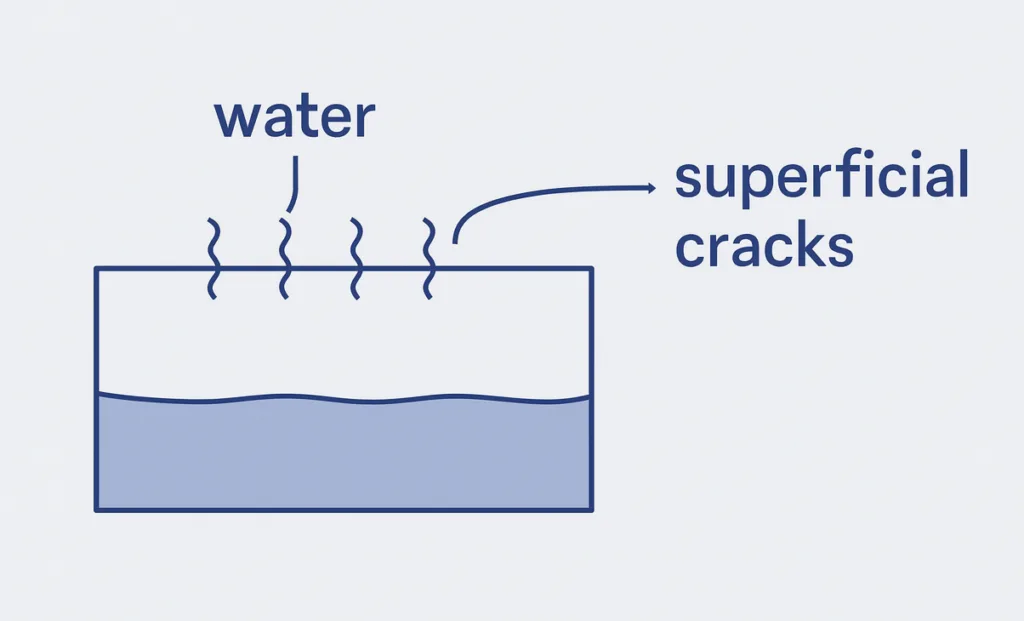
Due to loss of moisture from the top surface, a short-term process
Cracks generally develop on the top surface
Shrinkage occurred before the concrete hardened.
3) Autogenous shrinkage:
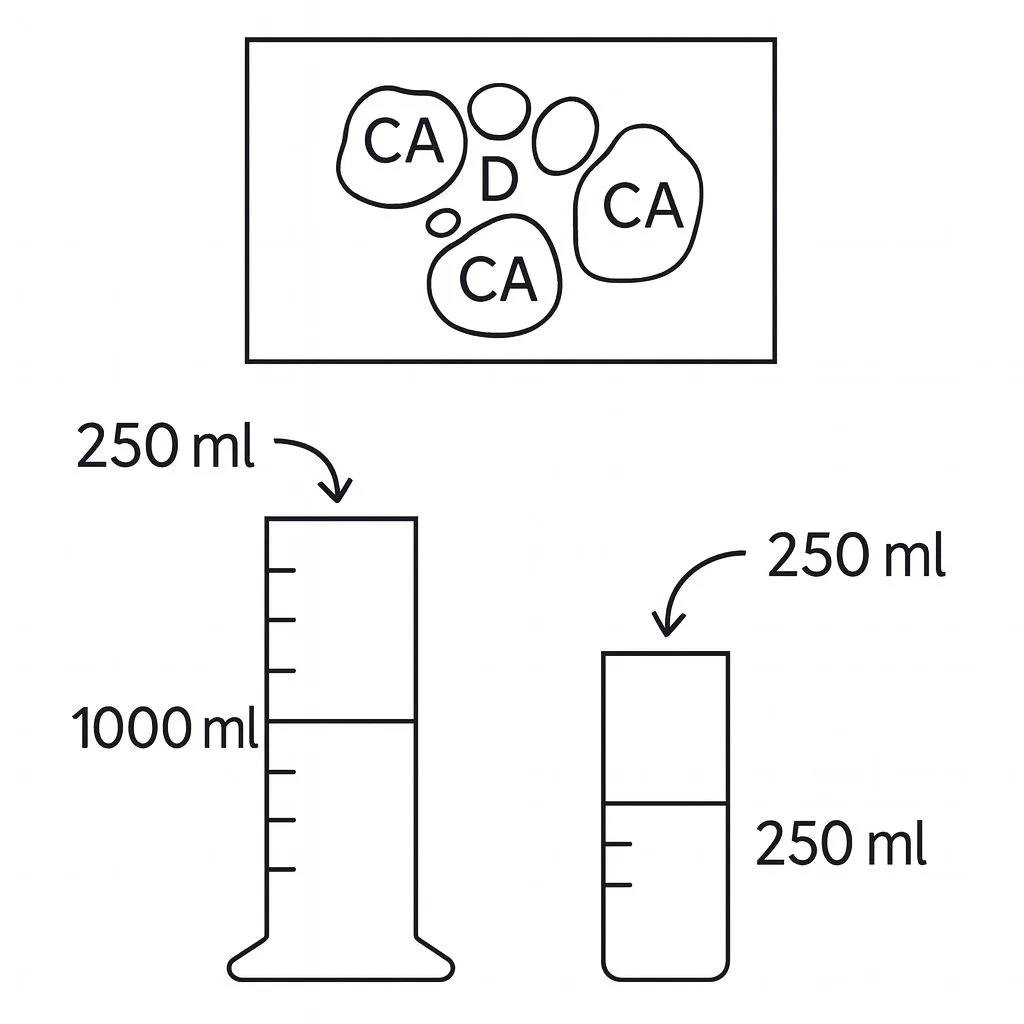
- Volume reduction if no moisture transfer outside
- Mainly due to self self-desiccation of cement (extreme state of dryness)
- Resulting in a rise in capillary pressure
- Increases as the grade of concrete increases
- Generally occurs in the early days
- short-term process
4) Drying shrinkage:
- Contraction of the hardened concrete due to loss of water from the pores
- The most important type of shrinkage
- Decreases as the grade of concrete ↑
- Long-term process
5) Carbonation shrinkage:
As the Ca(OH)₂ from concrete ↓, its pH ↓ and chance of corrosion ↑
Major factors that affect carbonation shrinkage are permeability of concrete, moisture content, RH and amount of CO₂ in the air.
The rate of carbonation shrinkage is very slow.
Reaction:
CO2+H2O→H2CO3
(atm. concrete)H2CO3+Ca(OH)2→CaCO3+2H2O
Effect of shrinkage:
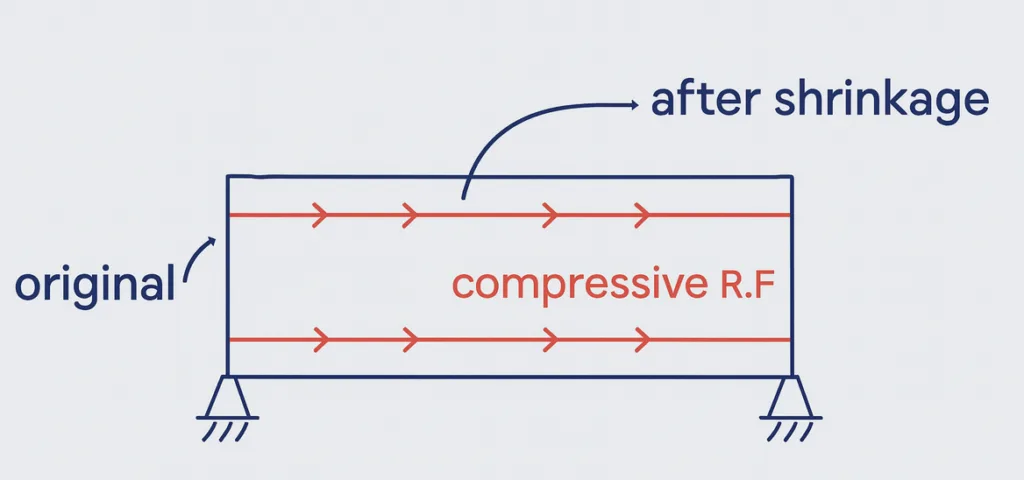
(Diagram showing original and after-shrinkage member with tensile R.F. at bottom & compressive R.F. at top)
In an unrestrained RCC member, the shrinkage of concrete results in shortening of the member. However, the embedded R/F resist the shortening, and as a result, the compressive stress is developed in both compressive R/F and tensile R/F.
For symmetrically placed R/F (that is, equal compressive and tensile R/F), shrinkage does not result in any curvature of the member fora determinant structure.
However, in an indeterminant structure, shrinkage results in an overall change of geometry.
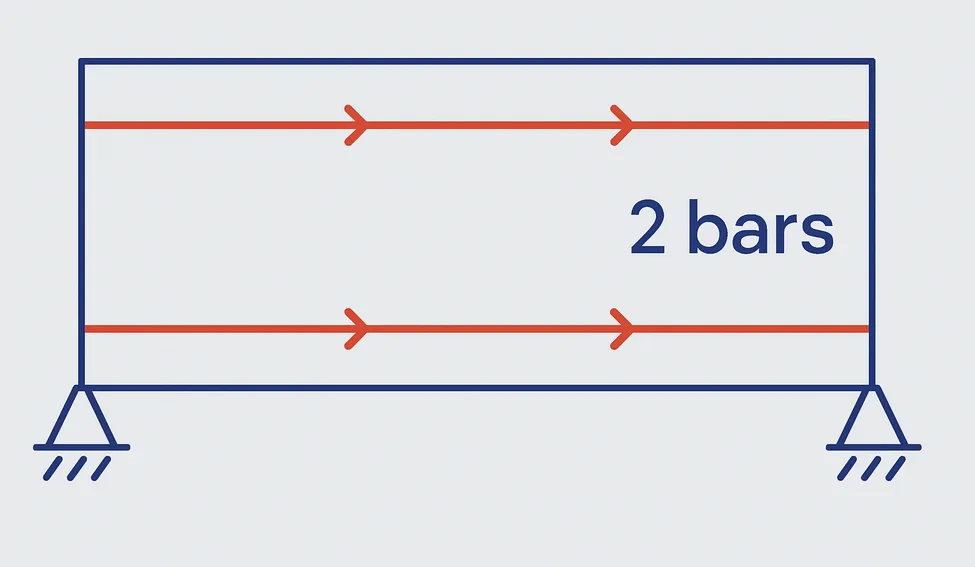
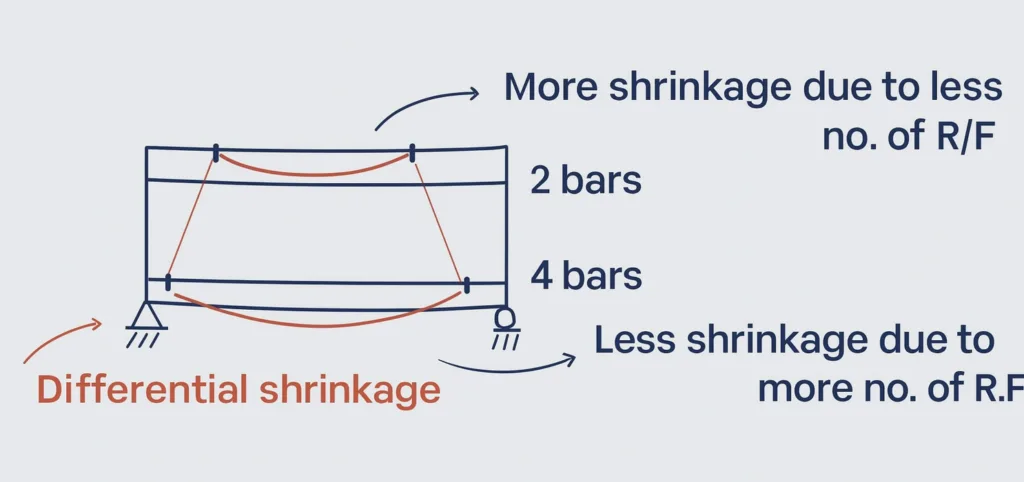
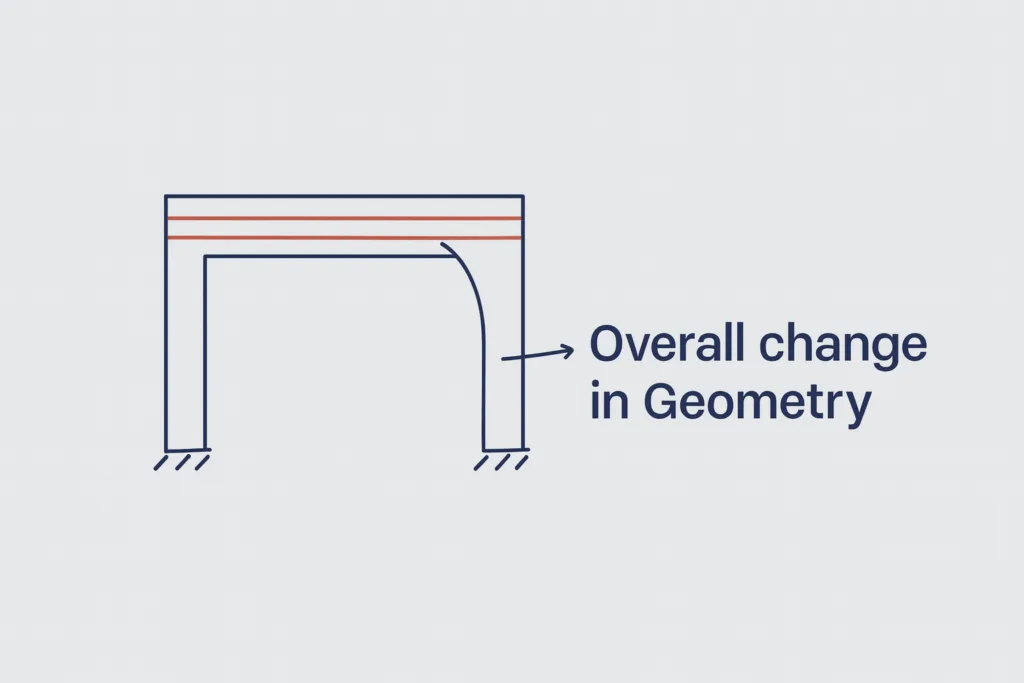
- In restrained RCC member Shrinkage develop Tensile Stress in concrete and compressive stress in both tensile and Compressive R/F.
- For unsymmetrically placed R/F (line in the flexural member) curvature results due to differential shrinkage.
- Both flexural curvature and shrinkage curvature are additive; hence the long-term deflection increases due to shrinkage.
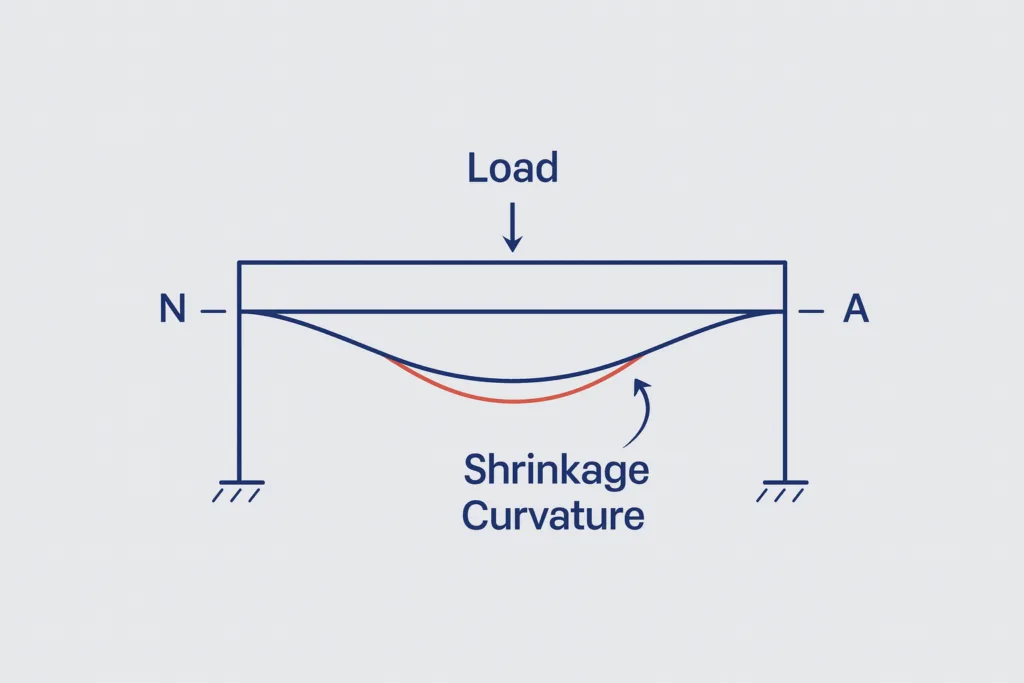
(Diagram showing shrinkage curvature)
Factors affecting shrinkage:
- All factors related to material property, composition, mix, curing and environmental conditions.
- Member size and age that affect creep also affect shrinkage.
- Also shrinkage is reversible to great extent i.e. alternative volume (in dry–wet condition) will cause alternating volume change in concrete.
Shrinkage for design:
- For normal concrete, generally drying shrinkage dominates.
- Generally, half of the total shrinkage occurs in first month and 3/4 in first 6 months.
- In the absence of test data the absolute value of shrinkage strain for design shall be taken as 0.0003 (3 × 10⁻⁴).
Shrinkage in Concrete: Types, Causes, Effects & Design Considerations Explained
- Creep of Concrete: Definition, Mechanisms, Effects & Long-Term Deflection Explained:- https://engineerlatest.com/creep-of-concrete-explained/#google_vignette
- Characteristic of an ideal site for a Bridge:- https://engineerlatest.com/characteristic-of-an-ideal-site-for-a-bridge/
- The Arch bridges and Cantilever Bridges:- https://engineerlatest.com/the-arch-bridges-and-cantilever-bridges/
- Steel Bridges Types and Benefits:- https://engineerlatest.com/steel-bridges-types-and-benefits/
- Truss Bridges, Types, Design Benefits, and Components Overview:- https://engineerlatest.com/truss-bridges-types-design-benefits-and-components-overview/
- Footings and Foundations Explained: Types, Functions, and IS 456 Guidelines:- https://engineerlatest.com/footings-and-foundations-explained/
- Back Stay Analysis in Tall Buildings | Direct vs Indirect Lateral Load Path Explained:- https://engineerlatest.com/back-stay-analysis-in-tall-buildings-direct-vs-indirect-lateral-load-path-explained/
5 comments