Column Slenderness and Second-Order Effects as per ACI 318-25
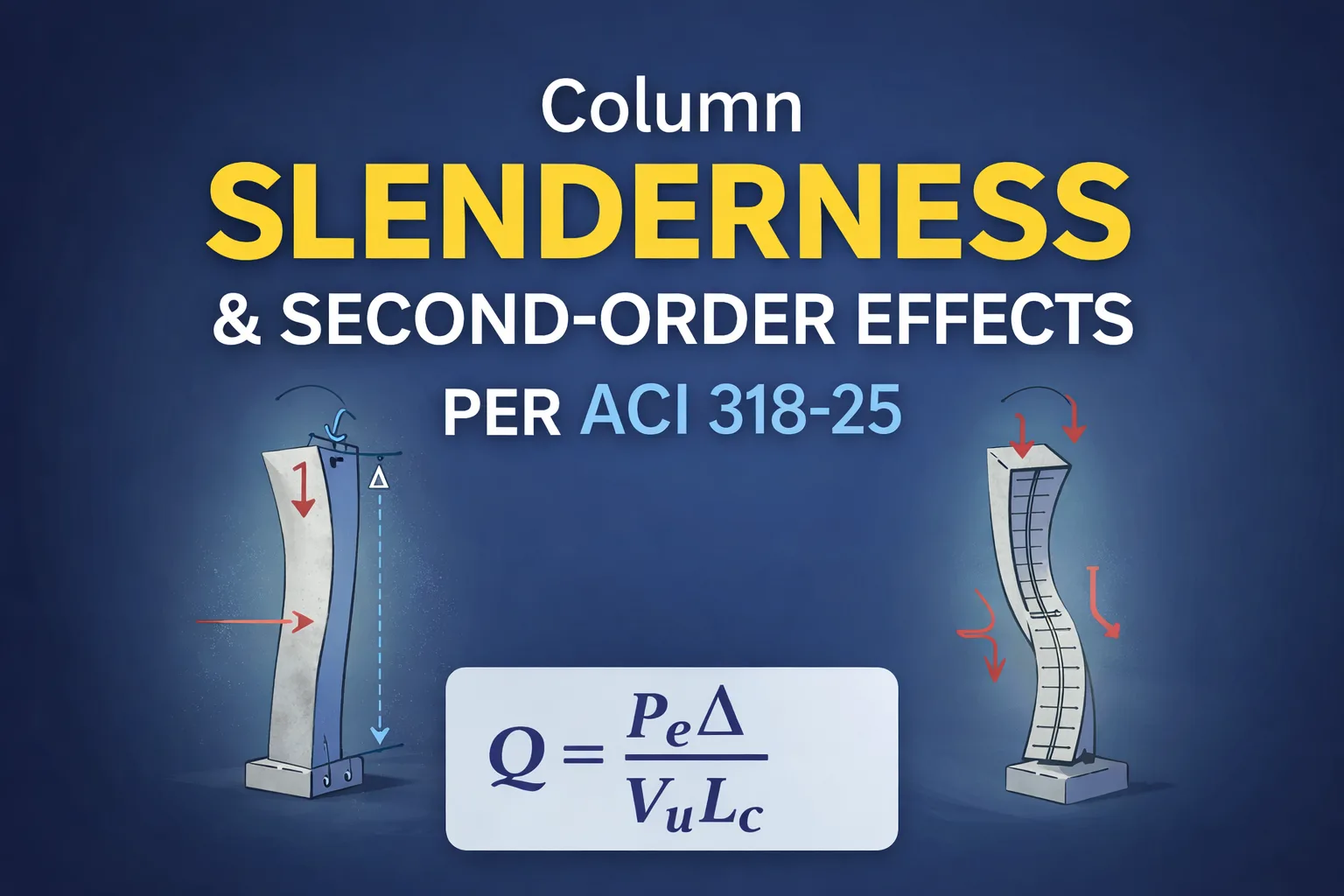
Table of Contents
Introduction
In reinforced concrete design, columns are critical structural elements that primarily resist axial loads along with bending moments. When columns become tall and slender, their behavior is no longer governed only by material strength but also by stability and deformation effects.
To address this, ACI 318-25 provides clear guidelines for column slenderness, second-order (P–Δ) effects, and moment magnification. This article explains these provisions in a simple, practical, and exam-oriented manner, using concepts directly derived from ACI 318-25.
What Is Column Slenderness?
Column slenderness refers to the tendency of a column to sway or buckle under axial compression due to its height relative to its cross-sectional dimensions.
In slender columns:
- Lateral deflection increases bending moments
- Stability governs the design
- Second-order effects become significant
ACI 318 controls this behavior using the slenderness ratio (KL/r).
Slenderness Limits as per ACI 318-25
1. Unbraced (Sway) Frames
For columns not braced against lateral displacement:rKLu≤22
If this limit is exceeded, second-order effects must be considered.
2. Braced (Non-Sway) Frames
When the structure is adequately braced against lateral movement:rKLu≤40
Additionally, the following limit must also be checked:rKLu≤34+12(M2M1)
The smaller (more restrictive) value governs.
Effective Radius of Gyration (r)
The radius of gyration is calculated as:r=AI
Approximate values allowed by ACI:
- Rectangular columns: r≈0.3h
- Circular columns: r≈0.25h
These simplifications help in quick preliminary checks.
Braced vs Unbraced Columns
- Braced columns resist lateral loads through shear walls, bracing, or rigid frames.
- Unbraced columns experience lateral displacement, making them more critical.
Unbraced columns are more sensitive to slenderness, and sway effects dominate their behavior. Single vs Double Curvature Behavior
Single Curvature
- Column bends in one direction
- End moments have the same sign
- (M1/M2) is negative
Double Curvature
- Column bends in two opposite directions
- End moments have opposite signs
- (M1/M2) is positive
This ratio directly affects allowable slenderness limits.


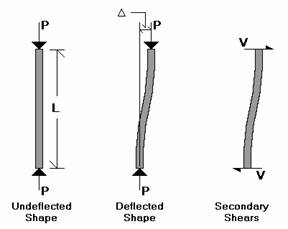
Second-Order (P–Δ) Effects
Second-order effects arise when:
- Axial load (P) acts on a laterally displaced column
- Additional moments are generated due to deflection (Δ)
These effects are not captured in first-order analysis and must be included when slenderness limits are exceeded.
Stability Index (Q)
ACI 318-25 introduces the stability index:Q=VuLcPuΔ
Where:
- Pu = factored axial load
- Δ = lateral displacement
- Vu = factored shear
- Lc = column height
Limit:
Q≤0.2
If Q > 0.2, second-order analysis is mandatory.
Moment Magnification Factor
To account for second-order effects, ACI allows moment magnification:δ≤1.4
This magnified moment is then used for column design instead of performing full nonlinear analysis.


Non-Sway Frame Check
A frame may be treated as non-sway if:
- Increase in moments from second-order effects
≤ 5% of first-order moments - Stability index:
Q≤0.05
This simplifies analysis and design.
Effect of Creep on Column Stability
For columns under sustained compression:
- Creep reduces effective stiffness (EI)
- Long-term deflections increase
- Slenderness effects become more pronounced
ACI explicitly requires creep effects to be considered in stability analysis.
Practical Design Takeaways
- Always check KL/r early in design
- Identify whether the frame is sway or non-sway
- Use moment magnification where permitted
- Consider creep and sustained loads
- Slenderness often controls design, not strength
Frequently Asked Questions (FAQ)
Q1. When is a column considered slender?
When the KL/r ratio exceeds ACI limits, second-order effects must be considered.
Q2. Is second-order analysis always required?
No. Moment magnification methods are allowed if limits are satisfied.
Q3. Why is creep important in column design?
Creep reduces stiffness and increases long-term deflections, affecting stability.
Column Slenderness and Second-Order Effects as per ACI 318-25
ACI 318-25 provides a clear and rational framework for handling column slenderness and second-order effects. Understanding these provisions is essential for safe and economical column design, especially in multi-storey buildings.




2 comments