Loads and Load Combinations as per ACI 318-25
Introduction
In reinforced concrete design, accurate estimation of loads is as important as member strength. Even a perfectly designed beam or column can fail if loads and load combinations are not considered correctly.
ACI 318-25, along with ASCE load provisions, defines how different loads should be applied and combined to ensure safety, serviceability, and stability of concrete structures. This article explains the load provisions, live load reduction, temperature effects, and load arrangement rules clearly and practically.
Types of Loads Considered in ACI 318-25
ACI 318-25 considers the following major load types:
1. Dead Load (D)
Dead load includes:
- Self-weight of structural members
- Floor finishes
- Permanent walls and partitions
Dead load is constant and always present throughout the life of the structure.
2. Live Load (L)
Live load represents:
- Occupancy loads
- Moving loads
- Temporary loads
Live loads can vary in magnitude and location, making them critical in design.
3. Roof Live Load (Lr)
Roof live load accounts for:
- Maintenance loads
- Temporary storage on roofs
It is treated separately from floor live load.
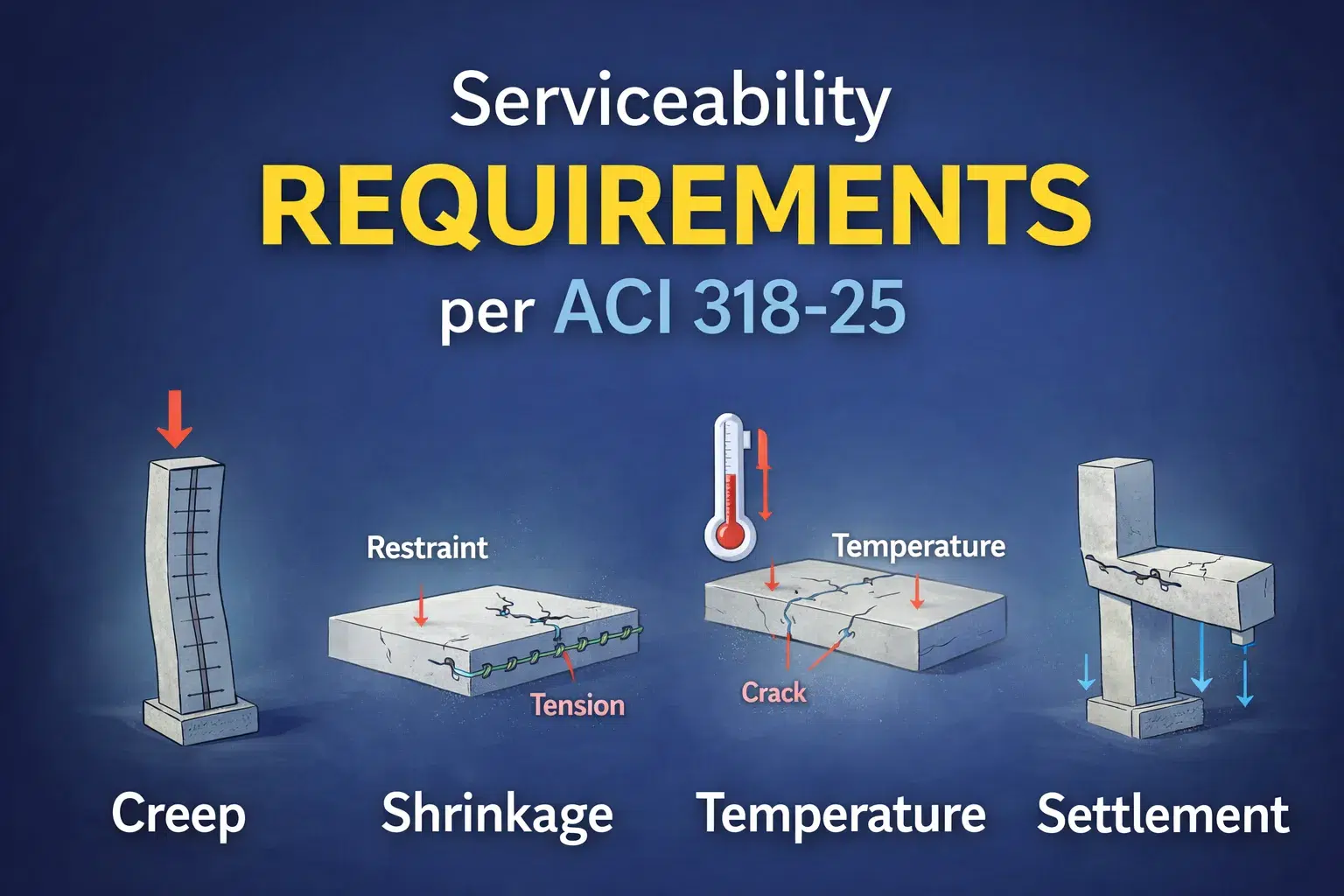
4. Environmental and Deformation Loads
ACI 318-25 also requires consideration of:
- Temperature effects (T)
- Shrinkage and creep
- Restraining effects
These loads may not always be visible but can cause significant internal stresses.
Load Combinations as per ACI 318-25
Load combinations ensure that the structure remains safe under worst-case realistic scenarios.
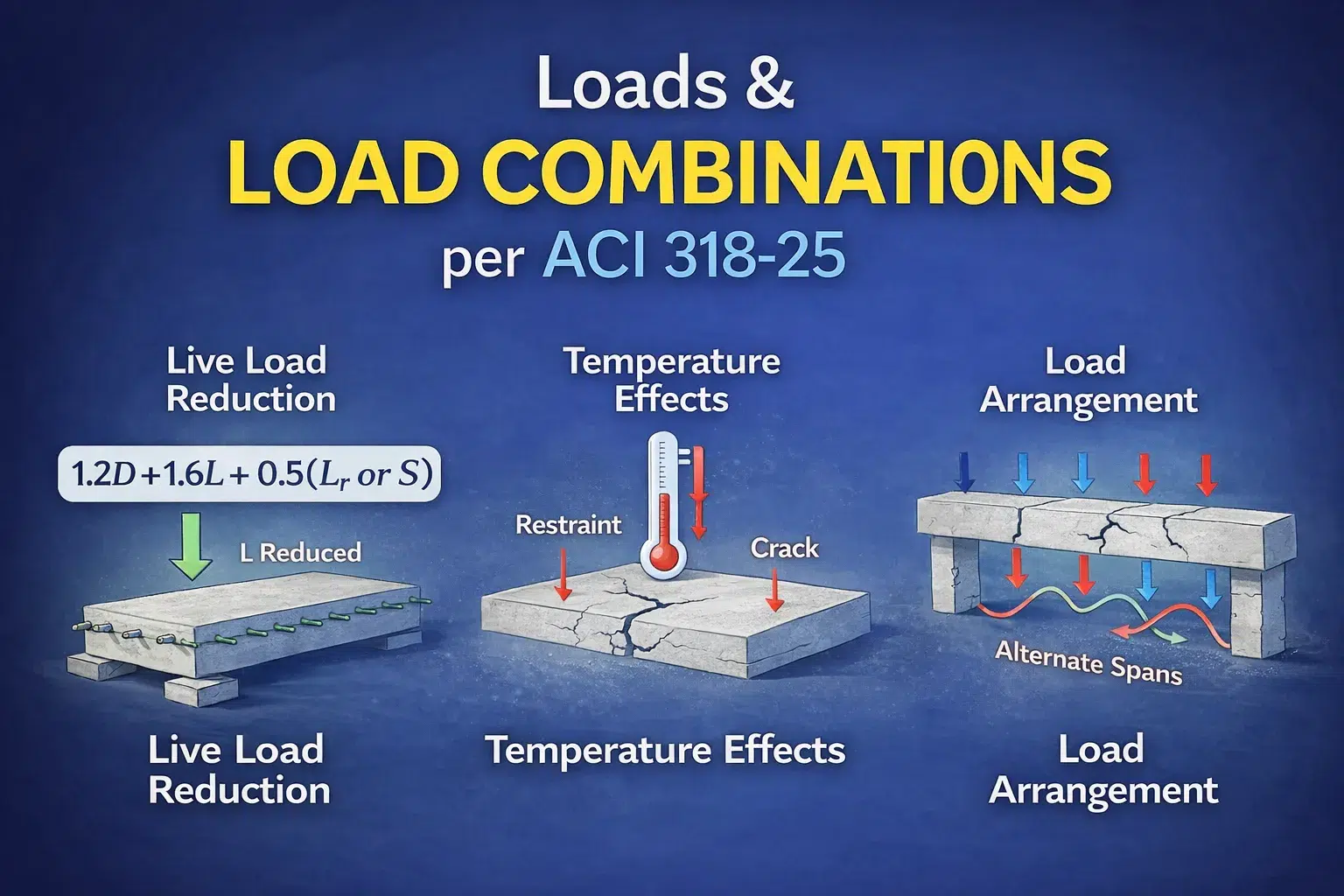
A commonly used factored load combination is:1.2D+1.6L+0.5(Lr or S)
Where:
- D = Dead load
- L = Live load
- Lr = Roof live load
- S = Snow load (if applicable)
Live Load Reduction (Section 5.3.3)
ACI 318-25 allows the reduction of live load in load combinations when:
- The loaded area is large
- Full live load is unlikely to act everywhere simultaneously
Reduced Live Load Combination:
1.2D+1.6L+0.5(Lr or S)
Exceptions (Live Load Reduction NOT allowed):
- Garages
- Areas where:
L>4.8 kPa
This provision results in an economical design without compromising safety.
Temperature and Volume Change Effects (Section 5.3.6)
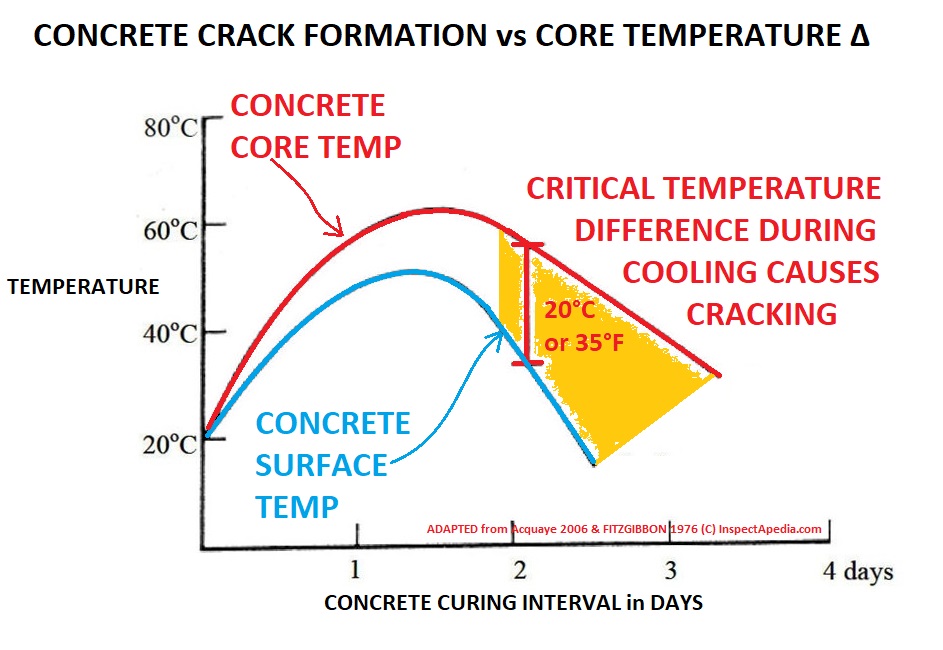
Temperature variation and volume changes due to shrinkage and creep can cause:
- Additional tensile stresses
- Cracking in slabs and walls
- Redistribution of forces
ACI Requirement:
Temperature and restraint effects must be included in load combinations where significant.
These effects are especially critical in:
- Long slabs
- Rigid frames
- Restrained structural systems


4
Load Arrangement for Beams and Slabs (Section 6.4)
One-Way Slabs and Beams
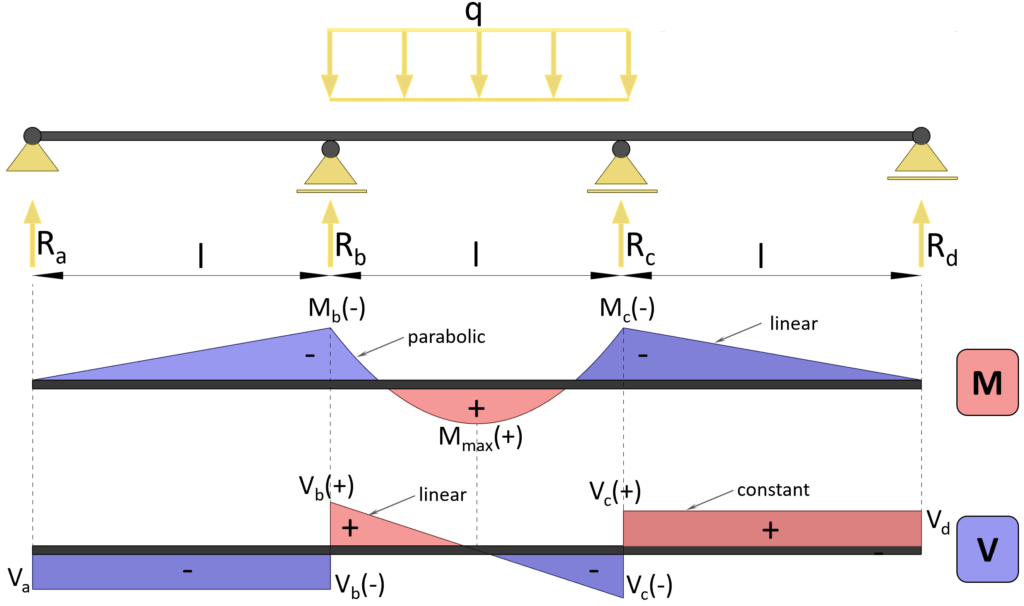
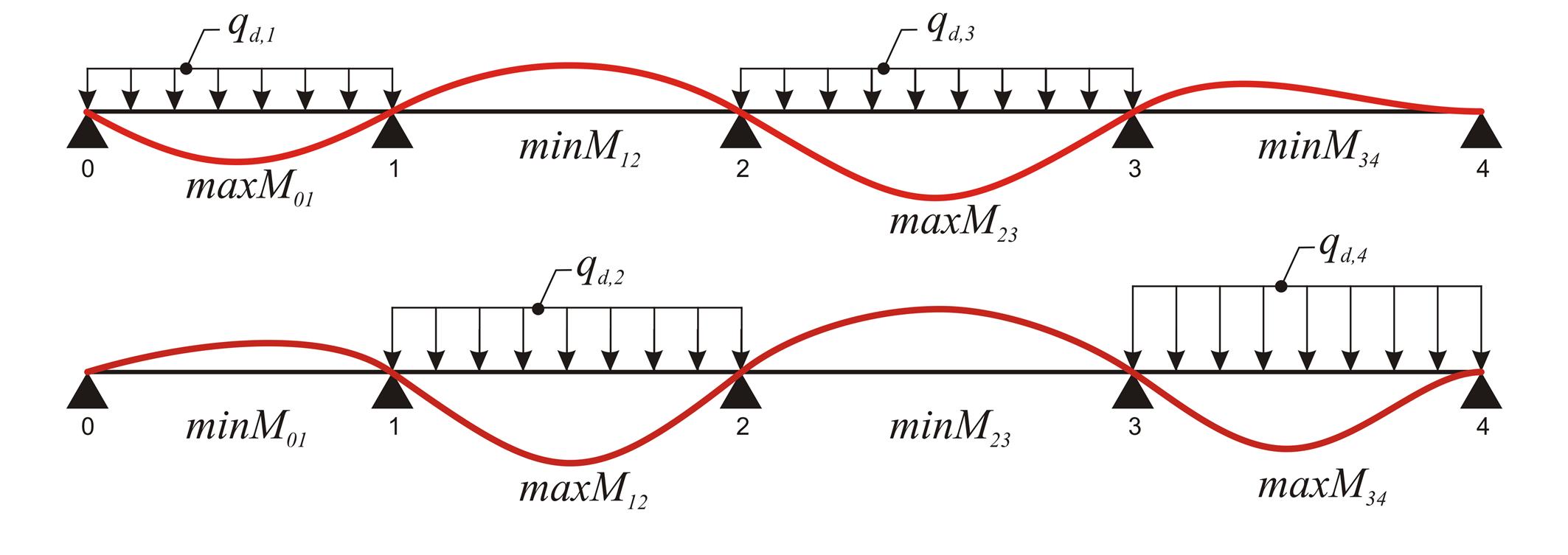
For one-way slabs and continuous beams:
- Live load should be placed on alternate spans
- This produces maximum positive and negative bending moments
This arrangement governs reinforcement design.
Two-Way Slabs and Beams
For two-way slabs:
- Live load should be applied to all panels
- Partial loading is not sufficient to capture worst-case effects

4
Importance of Proper Load Arrangement
Incorrect load arrangement may result in:
- Underestimation of moments
- Unsafe reinforcement detailing
- Serviceability problems
Correct loading ensures:
- Realistic structural behavior
- Safe design
- Code compliance
Practical Design Takeaways
- Always apply factored load combinations
- Use live load reduction carefully
- Do not ignore temperature and restraint effects
- Apply live load in alternate spans for continuous members
- Follow slab-specific loading rules
Frequently Asked Questions (FAQ)
Q1. Is live load reduction always permitted?
No. It is not allowed for garages or areas with live load exceeding 4.8 kPa.
Q2. Why are temperature effects included in load combinations?
Because restrained temperature movement can induce significant tensile stresses and cracking.
Q3. Why is alternate span loading important?
It produces maximum bending moments in continuous beams and slabs.
Conclusion
ACI 318-25 load provisions ensure that concrete structures are designed for realistic and critical loading conditions. Proper use of load combinations, live load reduction, temperature effects, and load arrangement leads to safer and more economical structures.
Column Slenderness and Second-Order Effects as per ACI 318-25:- https://engineerlatest.com/column-slenderness-and-second-order-effects-as-per-aci-318-25/



Post Comment