Shear Wave Velocity (Vs): A Complete Guide as per IS 1893:2025
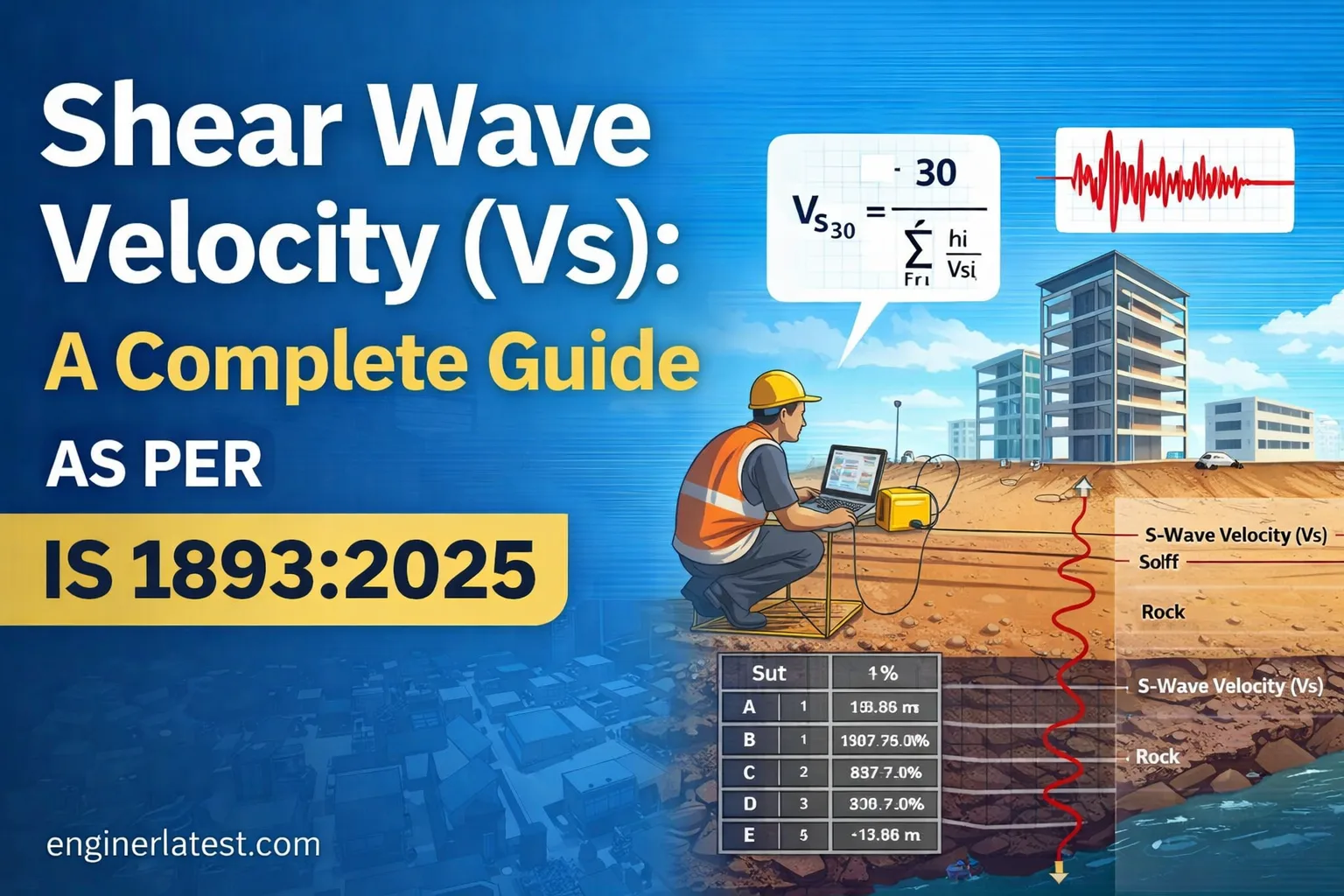
Table of Contents
Earthquake-resistant design does not depend only on how strong a building is, but also on how the ground below it behaves during seismic shaking.
One of the most important parameters used to understand this behavior is Shear Wave Velocity (Vs).
With the introduction of IS 1893:2025, shear wave velocity has become a primary parameter for site classification, replacing many older empirical methods.
This article explains the concept, logic, calculation, tests, and design significance of shear wave velocity in a simple and practical manner.
What Is Shear Wave Velocity (Vs)?
Shear Wave Velocity (Vs) is the speed at which shear (S) waves travel through soil or rock.
It is expressed in m/s.
In simple words:
- Vs tells us how stiff the soil is
- Stiffer soil → higher Vs
- Softer soil → lower Vs
Why Vs Is Important?
- It represents dynamic soil stiffness
- It controls seismic amplification
- It directly affects earthquake forces on structures
Effect of Vs on Seismic Response
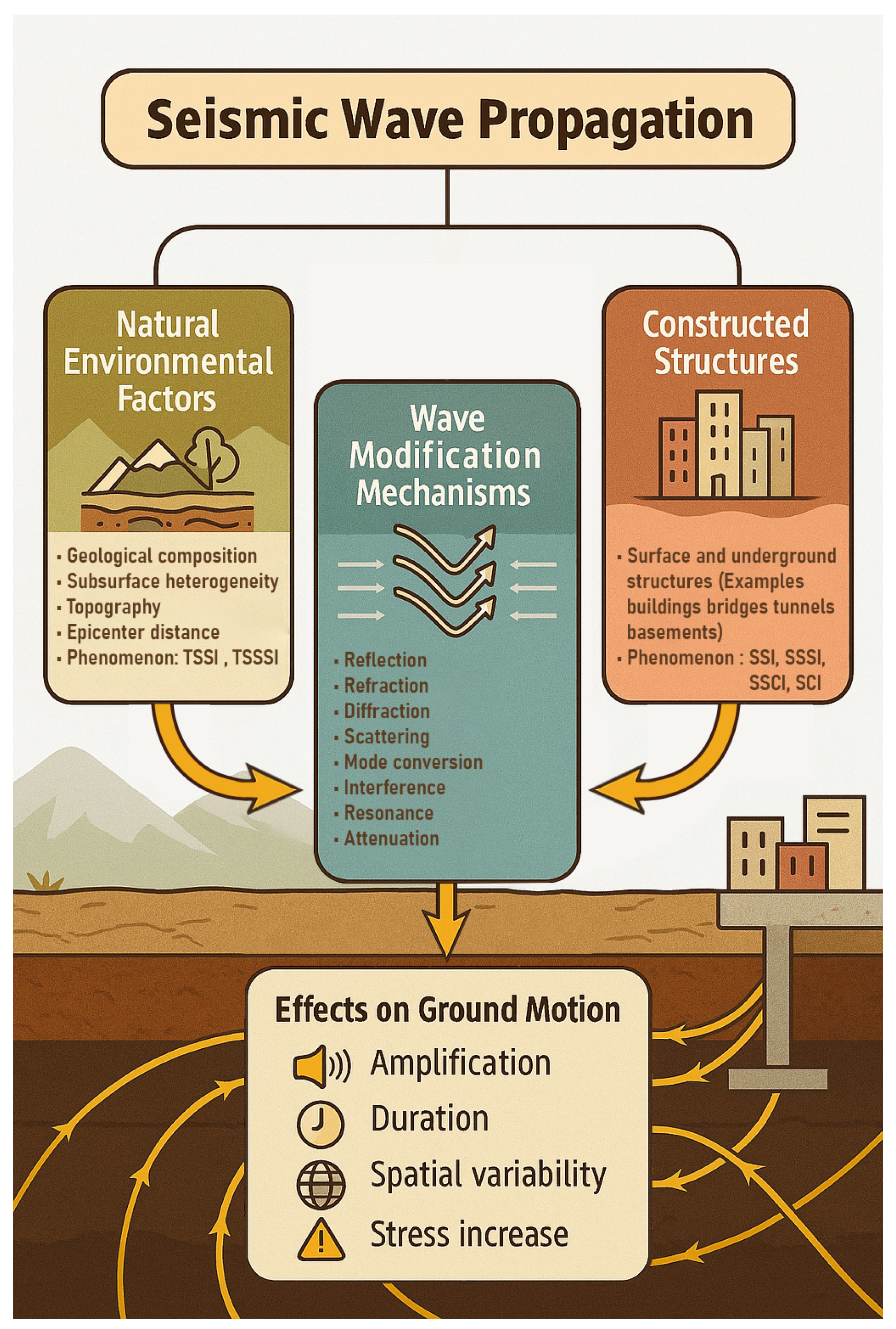
- Lower Vs (soft soil)
→ Higher seismic amplification
→ More dangerous for tall buildings - Higher Vs (stiff soil or rock)
→ Lower amplification
→ Safer seismic behavior
This is why two buildings with the same design can behave very differently during an earthquake if they are built on different soils.
Why IS 1893:2025 Introduced Shear Wave Velocity?
Earlier codes (like IS 1893:2016) relied mainly on:
- SPT-N values
- General soil descriptions
These methods were:
- Empirical
- Uncertain for dynamic behavior
IS 1893:2025 Improvements
- Earthquake response depends more on soil stiffness, not just strength
- Vs directly reflects dynamic soil behavior
- It aligns Indian practice with global seismic codes such as ASCE-7, Eurocode, and NEHRP
Site Classification as per IS 1893:2025 (Table 6.1)
| Site Class | Average Shear Wave Velocity (Vs) |
|---|---|
| A | ≥ 1500 m/s |
| B | 760 – 1500 m/s |
| C | 360 – 760 m/s |
| D | 180 – 360 m/s |
| E | ≤ 180 m/s |
This classification is mandatory for seismic design under the new code.
Calculation of Average Shear Wave Velocity: The weighted average shear wave velocity is calculated as:
Vs = Σ ti / Σ (ti / Vsi)
Where:
- ti = thickness of soil layer i
- Vsi = shear wave velocity of soil layer i
- N = number of soil layers within the depth of influence
The depth of influence must be selected as per Table 8.5 of IS 1893:2025.
Vs₃₀ (Average Vs of Top 30 m)

Vs₃₀ is the average shear wave velocity of the top 30 m of soil and is calculated using:
Vs₃₀ = 30 / Σ (hi / Vsi)
Where:
- hi = thickness of soil layer i
- Vsi = shear wave velocity of layer i
This formula represents a harmonic mean, meaning:
- Each soil layer contributes according to travel time
- Thicker and softer layers influence results more
Direct Effect of Vs on Seismic Design Parameters
1. Design Response Spectrum
- Lower Vs → higher spectral acceleration
- Dominant period shifts to higher values
2. Base Shear
- Softer sites attract a larger design base shear
3. Time Period Compatibility
- Soil natural period depends on Vs and depth
- If soil period ≈ building period → resonance occurs
- Tall buildings on soft soil are most vulnerable
4. Vertical Ground Motion
- Vs also governs vertical site amplification
- Critical for transfer girders, flat slabs, and industrial structures
Common Shear Wave Velocity Tests
| Test Method | Cost | Application |
|---|---|---|
| MASW | Low | Routine buildings |
| Downhole | Moderate | High-rise & industrial |
| Crosshole | High | Critical structures |
| ReMi | Moderate | Urban areas |
| Seismic Refraction | Low | P-wave only |
Engineering Preference for Vs Tests
Routine buildings → MASW
- High-rise / industrial → MASW + Downhole
- Critical structures → Crosshole
- Urban constraints → ReMi (supporting test)
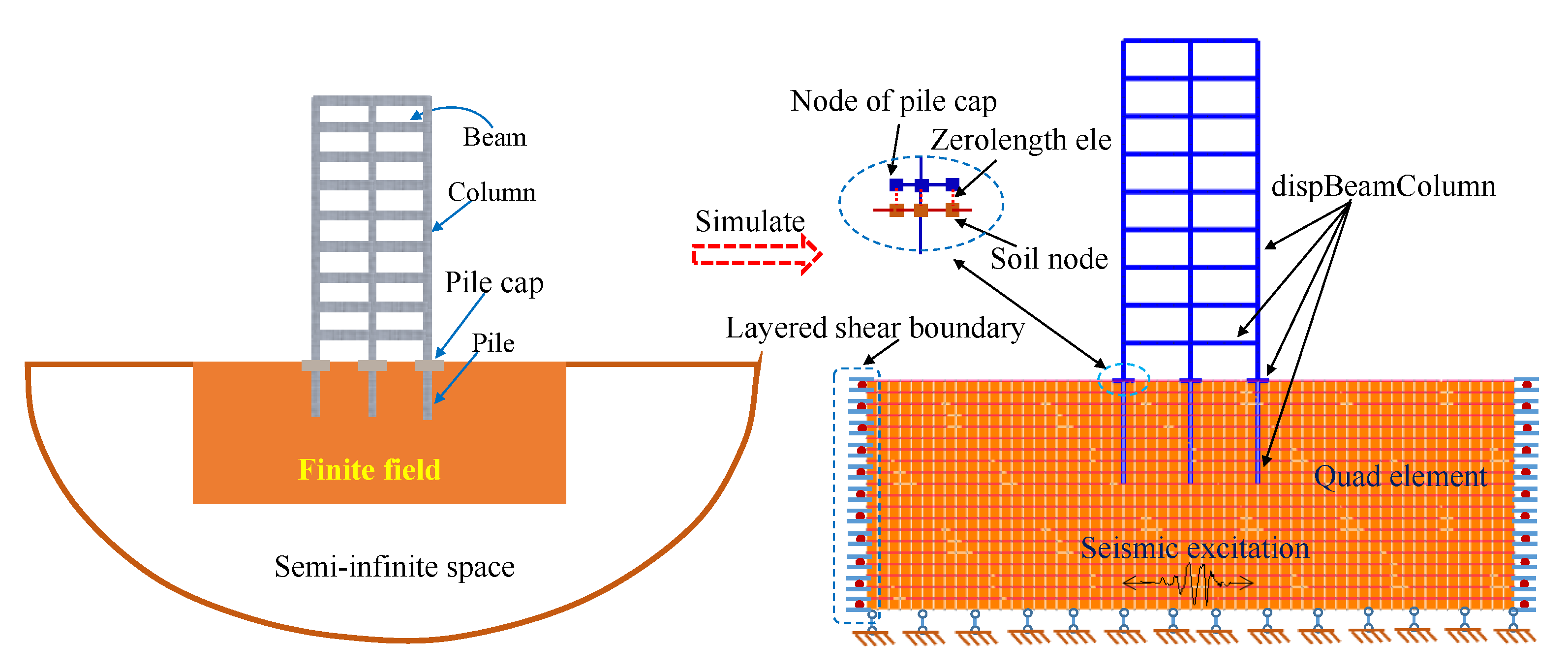
Soil–Structure Interaction and Vs
Lower Vs indicates:
- Higher foundation flexibility
- Increased structural drift demand
- Redistribution of forces in walls and columns
Thus, Vs plays a key role in soil–structure interaction analysis.
Shear Wave Velocity (Vs): A Complete Guide as per IS 1893:2025
Shear Wave Velocity is not just a geotechnical parameter—it is a bridge between soil behavior and structural performance.
With IS 1893:2025, Indian seismic design has taken a scientific and globally aligned step forward.
Understanding Vs properly helps engineers design safer, smarter, and more economical structures.
Important Surveying, Photogrammetry and Remote Sensing Concepts for Civil Engineers:- https://engineerlatest.com/surveying-photogrammetry-remote-sensing-concepts/
Understanding the Overstrength Factor in Structural Engineering | IS 1893: 2025 Guide:- https://engineerlatest.com/nderstanding-overstrength-factor-structural-design/
Time Concept in Surveying: Sidereal, Solar, Mean & Standard Time Explained:- https://engineerlatest.com/time-concept-in-surveying/


Post Comment