Time Concept in Surveying: Sidereal, Solar, Mean & Standard Time Explained
Table of Contents
Time Concepts in Surveying and Astronomy (Explained Simply)
Understanding time is very important in surveying, astronomy, navigation, and geography. Time measurement is closely related to the rotation of the Earth, the movement of the Sun, and the position of stars. In this article, we explain different time concepts in simple language, exactly as required for civil engineering and surveying students.
Latitude and Longitude (Basic Idea)
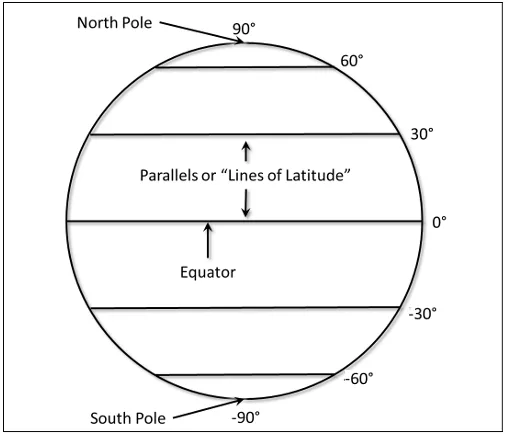
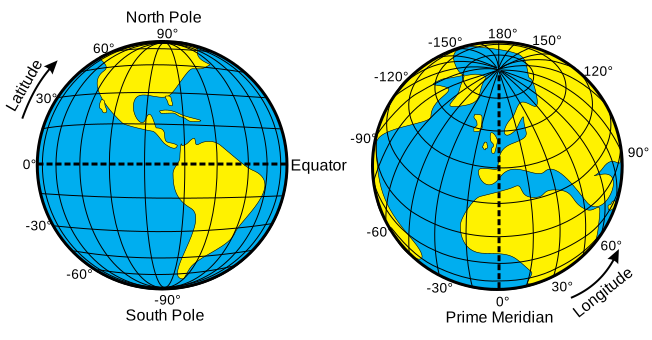
- Latitude: Imaginary lines drawn parallel to the equator, measured in the north–south direction.
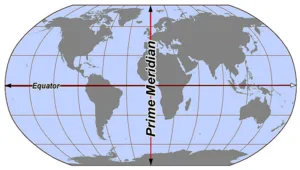
- Longitude: Imaginary lines joining the North Pole and South Pole, measured in the east–west direction.
Latitude and longitude together help in identifying the exact location of any place on Earth.
1. Sidereal Time
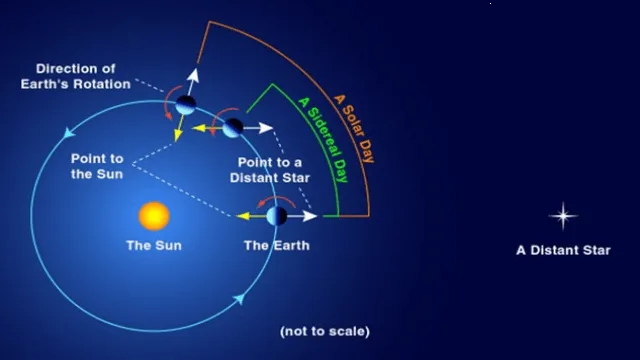
Sidereal time is the measurement of time based on the rotation of the Earth with respect to fixed stars, especially the First Point of Aries.
Sidereal Day
- A sidereal day is the time interval between two successive upper transits of the First Point of Aries across a meridian.
- It begins when the First Point of Aries crosses the meridian.
- Sidereal time is measured from 0 to 24 hours westward.
Key Points
- One sidereal day = 24 sidereal hours
- Each hour = 60 minutes, each minute = 60 seconds
- 1 solar year = 366.2422 sidereal days
📌 Sidereal time is mainly used in astronomy, not in daily life.
2. Apparent Solar Time (AST)

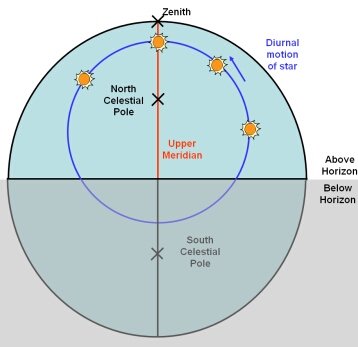
Apparent Solar Time is based on the actual movement of the Sun around the Earth as observed from a fixed location.
Apparent Solar Day
- It is the time interval between two successive transits of the Sun over the same meridian.
- Since the Earth’s orbit is elliptical, the apparent solar day is not uniform throughout the year.
Importance
Because human life depends on day and night, apparent solar time is naturally suitable for daily activities, but it is not uniform, which creates difficulties for accurate timekeeping.
3. Mean Solar Time
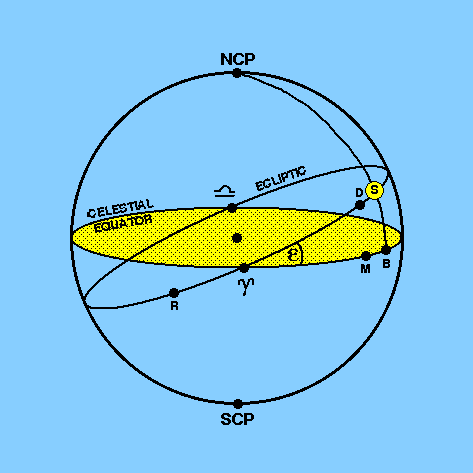

To overcome the irregularity of apparent solar time, the concept of mean solar time was introduced.
Mean Sun Concept
- A fictitious sun, called the Mean Sun, is assumed to move at a uniform speed along the equator.
- The time based on this imaginary sun is called mean solar time.
Mean Solar Day
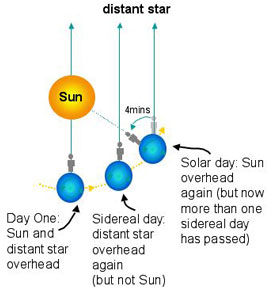
- The time interval between two successive transits of the mean sun over a meridian.
- This time is uniform and suitable for clocks and watches.
Local Mean Time (LMT)
- Mean solar time corresponding to the longitude of a particular place is called Local Mean Time.
- LMT differs from place to place because longitudes are different.
4. Standard Time
Since Local Mean Time changes with longitude, it can cause confusion within a country. To avoid this, standard time is adopted.
Standard Time Concept
- A single standard meridian is selected for the entire country.
- The local mean time of that meridian is taken as the standard time.
Standard Time of India
- India follows Indian Standard Time (IST).
- IST is based on the 82°30′ East longitude, which passes near Prayagraj (Allahabad).
- IST is 5 hours 30 minutes ahead of GMT.
Sidereal Year
A sidereal year is defined as:
- The time interval between two successive vernal equinoxes, or
- The time taken by the Earth to complete one revolution around the Sun with respect to fixed stars.
Difference Between Time Systems (Quick Summary)
| Type of Time | Based On | Uniform | Used For |
|---|---|---|---|
| Sidereal Time | Fixed stars | Yes | Astronomy |
| Apparent Solar Time | Actual sun | No | Natural observation |
| Mean Solar Time | Mean sun | Yes | Clocks & watches |
| Standard Time | Selected meridian | Yes | Civil life |
Why This Topic Is Important for Students
- Frequently asked in surveying exams
- Helps in understanding longitude, meridians, and time correction
- Useful in astronomical observations and navigation
- Important for competitive exams and interviews
Important Surveying, Photogrammetry and Remote Sensing Concepts for Civil Engineers:- https://engineerlatest.com/surveying-photogrammetry-remote-sensing-concepts/
Understanding the Overstrength Factor in Structural Engineering | IS 1893: 2025 Guide:- https://engineerlatest.com/nderstanding-overstrength-factor-structural-design/







Post Comment