Earthquake-Resistant Building Design in India: What Really Matters on Site
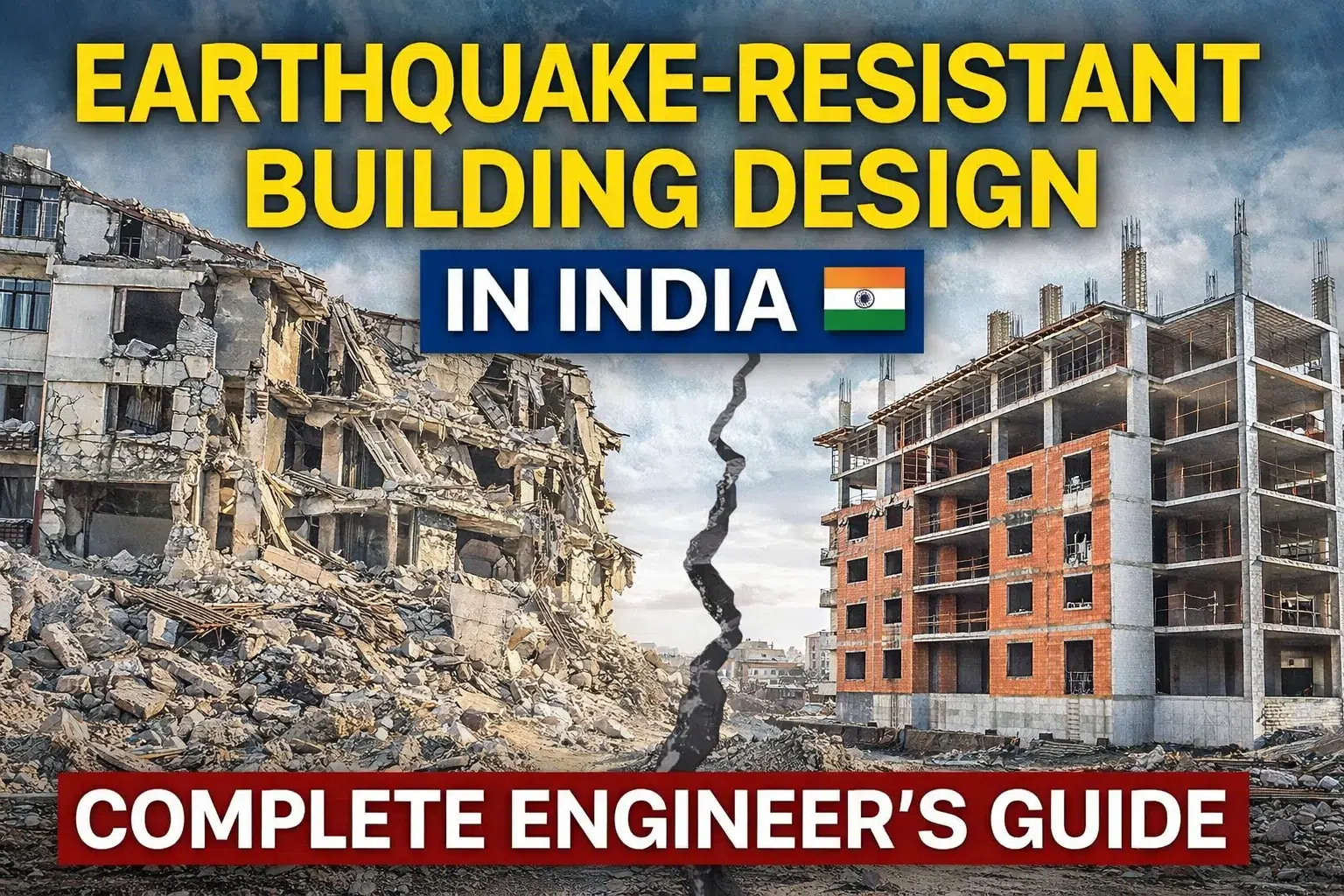
Table of Contents
Earthquake-Resistant Building Design in India In India, we usually start talking about earthquake safety after a major earthquake happens. News channels show collapsed buildings, social media is full of opinions, and then—slowly—everything is forgotten.
But for a structural engineer, earthquake-resistant design is not a trend or a discussion topic. It is a daily responsibility.
Earthquakes don’t kill people. Poorly designed and poorly constructed buildings do.
Yes i explain earthquake-resistant building design in India in a practical, real-world way—not just codes and formulas, but what actually matters during design and construction.
Why Earthquake-Resistant Design Is Non-Negotiable in India
India is divided into multiple seismic zones, and a large portion of the country falls under moderate to severe seismic risk. Still, many RCC buildings are designed with minimal consideration for earthquake forces.
In most building failures, gravity load is not the problem. Buildings collapse because:
- Lateral forces are underestimated
- Columns fail before beams
- Ductile detailing is ignored
- Construction quality is poor
Earthquake-resistant design does not mean the building will have zero damage. It means:
- The building should not collapse
- Occupants should get time to evacuate safely
- Damage should be repairable
A cracked building that stands is a success. A perfect-looking building that collapses is a failure.
Indian Codes: Good on Paper, Weak on Site
India already has clear and sufficient codes for earthquake-resistant design. The problem is not the absence of rules—it is non-compliance.
The codes used in practice include:
- IS 1893 for seismic load calculation
- IS 456 for RCC design
- IS 13920 for ductile detailing
If these codes are followed honestly, most buildings can survive strong shaking without collapse.
However, in real projects:
- Seismic loads are reduced to save steel
- Ductile detailing drawings are ignored on-site
- Supervision is weak
- Contractors prioritize speed over safety
This gap between the design office and the construction site is one of the biggest reasons for earthquake damage in India.
What Earthquake-Resistant Design Really Focuses On
Many people think earthquake-resistant design means making buildings very strong. That is incorrect.
Good seismic design focuses on controlled behavior, not brute strength.
The real objectives are:
- Proper load path for seismic forces
- Adequate lateral stiffness
- High ductility
- Energy dissipation through yielding
This is why concepts like strong column–weak beam, shear walls, and ductile reinforcement detailing are so important.
A building should bend and absorb energy, not break suddenly.
Role of Shear Walls and Structural Configuration
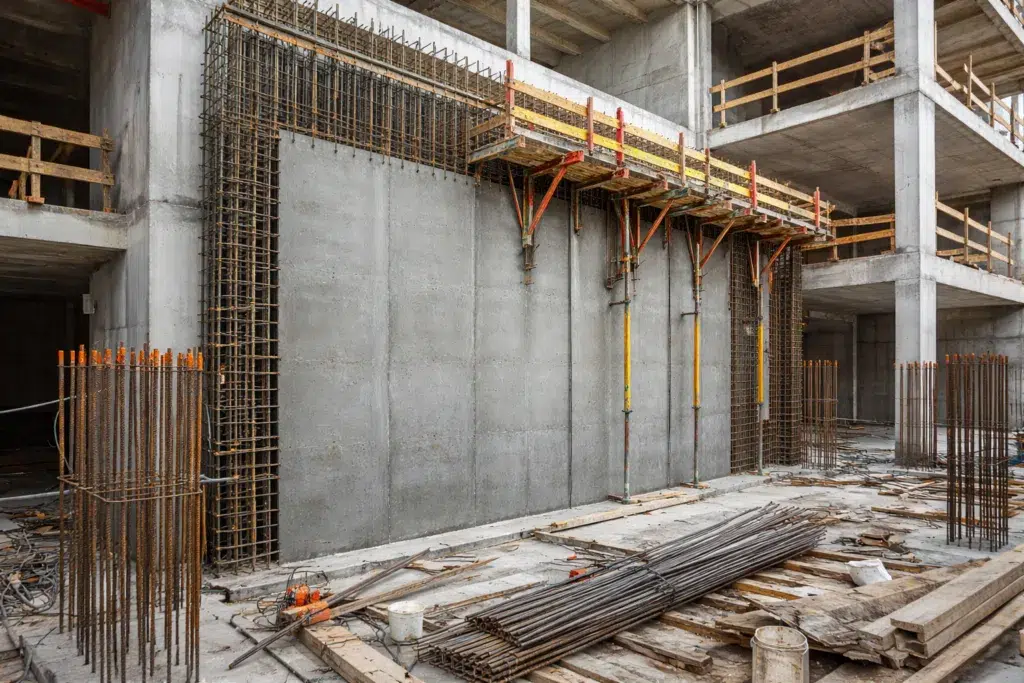
In practice, one of the most effective seismic elements is the shear wall. When placed correctly, shear walls:
- Reduce lateral displacement
- Control drift
- Protect columns and beams
However, shear walls are often:
- Placed randomly
- Added only to lift cores without analysis
- Avoided due to architectural resistance
Irregular building shapes, soft storeys, and floating columns are still common—especially in urban residential projects. These features may look attractive, but they perform poorly during earthquakes.
A regular and symmetric structural configuration is still one of the cheapest seismic safety measures.
The Cost Myth: “Earthquake-Resistant Buildings Are Expensive”
This is one of the most damaging myths in construction.
In most RCC buildings:
- Additional cost for proper seismic design is around 5–10%
- This includes extra steel, shear walls, and detailing
Compare this with:
- Cost of repairs after damage
- Loss of life
- Legal liability
- Demolition and reconstruction
Earthquake-resistant design is not expensive.
Ignoring it is.
The real high cost comes when we try to retrofit unsafe buildings later.
Construction Quality: The Weakest Link
Even the best seismic design can fail if construction quality is poor.
Common site issues include:
- Missing or reduced stirrups
- Incorrect lap lengths
- Improper anchorage
- Poor concrete compaction
- Unauthorized changes during execution
Many buildings fail not because the engineer made a mistake, but because drawings were not followed on site.
This is why site supervision and coordination between the designer, contractor, and client are critical for seismic safety.
Earthquake-Resistant Design Is a Responsibility, Not Just a Code
For structural engineers, seismic design should never be treated as a checkbox exercise. Every column tie, every hook angle, and every shear wall location affects human life.
Earthquake-resistant design is not about fear. It is about preparedness.
India will continue to experience earthquakes. The real question is:
Will our buildings be ready?
Final Thoughts
Earthquake-resistant building design in India does not require futuristic technology or massive budgets. It requires:
- Awareness
- Ethical engineering
- Proper detailing
- Respect for codes
- Quality construction
As engineers, we may not control earthquakes—but we do control how our buildings respond to them.
That responsibility should never be taken lightly.
Earthquake-Resistant Building Design in India
Written by a Abhimanyu, Structural Engineer with practical experience in seismic design and RCC buildings.
- Creep of Concrete: Definition, Mechanisms, Effects & Long-Term Deflection Explained:- https://engineerlatest.com/creep-of-concrete-explained/#google_vignette
- Shrinkage in Concrete: Types, Causes, Effects & Design Considerations Explained:– https://engineerlatest.com/shrinkage-in-concrete-types-effects-design/
- Working Stress Method (WSM) in RCC:- https://engineerlatest.com/working-stress-method-in-rcc/
- Steel Bridges Types and Benefits:- https://engineerlatest.com/steel-bridges-types-and-benefits/
- Truss Bridges, Types, Design Benefits, and Components Overview:- https://engineerlatest.com/truss-bridges-types-design-benefits-and-components-overview/
- Footings and Foundations Explained: Types, Functions, and IS 456 Guidelines:- https://engineerlatest.com/footings-and-foundations-explained/
- Differences Between IS 1893:2016 and IS 1893:2025 for Earthquake Resistant Design:- https://engineerlatest.com/differences-between-is-18932016-and-is-18932025-for-earthquake-resistant-design/





1 comment